Category: Faithfulness

Reflections on steady obedience to Christ in ordinary life.

  • The Abundance Problem

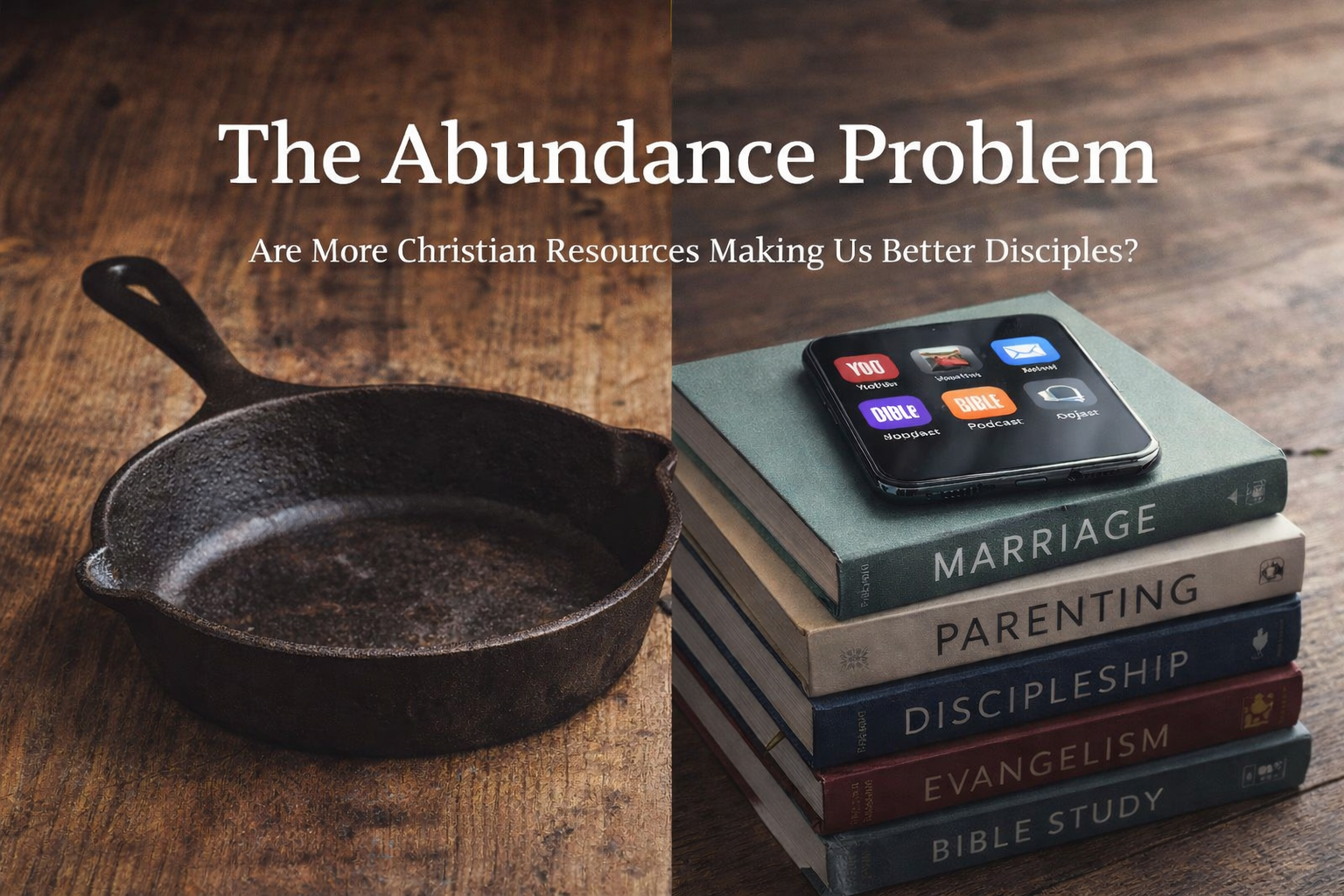
    The Abundance Problem

    Are More Christian Resources Making Us Better Disciples?

    A century ago, the average home kitchen was small and simple.

    A homemaker might have had a cast-iron skillet, a few pots, a knife or two, and a wooden spoon worn smooth from years of use.

    There was no refrigerator humming in the corner.
    No electric mixer on the counter.
    No microwave.
    No air fryer.
    No wall of gadgets promising to make cooking easier.

    There was certainly no infinite library of recipes available with a swipe of the thumb.

    And yet families cooked.

    Meals were prepared daily.
    Children were fed.
    Tables were filled.


    Today, our kitchens are larger, brighter, and filled with tools that would have seemed miraculous a century ago.

    We have every convenience imaginable.

    Entire aisles of stores are devoted to specialty cookware.
    The internet offers endless recipe libraries.
    Thousands of cooking videos are available in seconds.

    And yet many of those beautiful kitchens sit quietly.

    DoorDash arrives at the front door.
    Takeout bags pile up on the counter.
    Meals are eaten from containers while standing in a room full of appliances designed to make cooking easier than ever.

    The problem, it turns out, is not a lack of tools.

    The problem is that having more tools does not necessarily make us people who cook.

    Something similar has happened in the modern Christian life.

    Today, we live in an age overflowing with Christian resources.


    The Explosion of Christian Resources

    A hundred years ago, the average Christian home had very few resources.

    Most believers owned a Bible, perhaps a hymnal, and maybe one or two devotional books if they were fortunate.

    There were no sermon podcasts.
    No conference circuits.
    No YouTube theology channels.
    No endless supply of Bible apps and reading plans.

    There were certainly no shelves of niche books promising to solve every area of life.

    Today the situation is very different.

    Christian bookstores overflow with titles on marriage, parenting, leadership, evangelism, prayer, church growth, and spiritual formation.

    Podcasts deliver sermons by the thousands.

    Bible apps offer dozens of reading plans.

    Commentaries and teaching series are available instantly.

    We now have access to more Christian teaching in a single week than many believers in earlier generations heard in their entire lives.


    An Honest Question

    Has this abundance produced deeper obedience to Jesus?

    Are Christian marriages stronger because of the avalanche of marriage books?

    Are Christian parents more faithful because of the endless stream of parenting resources?

    Are churches more compelling witnesses to the gospel because of all the strategies and systems we can now study?

    It is difficult to look honestly at the spiritual landscape and conclude that the answer is yes.


    The Subtle Danger of Abundance

    The issue is not that Christian books are bad.

    Many of them are helpful. Faithful teachers have served the church well through their writing.

    But there is a subtle danger that comes with abundance.

    We can begin to confuse learning about obedience with actually obeying.

    We read about prayer instead of praying.
    We listen to sermons instead of repenting.
    We discuss discipleship instead of practicing it.

    Information multiplies quickly. Obedience grows slowly.

    Scripture anticipated this danger long ago:

    “Be doers of the word, and not hearers only, deceiving yourselves.”
    James 1:22

    It is possible to hear truth constantly and yet remain unchanged by it.

    In fact, an endless stream of teaching can create the illusion that we are growing simply because we are always learning something new.


    The Path Has Always Been Simpler

    Following Jesus has never been primarily about gathering more information.

    The path of discipleship has always been much simpler and much harder at the same time:

    Hear the Word.
    Believe the Word.
    Obey the Word.

    The Spirit of God forms Christ in us not through an endless supply of explanations, but through humble hearts that actually yield to what God has said.


    The Pattern Scripture Actually Gives Us

    The New Testament does not picture discipleship primarily happening through books.

    It imagines it happening through people.

    In Epistle to Titus 2, Paul describes a very simple pattern for how believers grow.

    Older men teaching younger men.

    Older women training younger women.

    Not through lectures or programs, but through shared life.

    Through example.

    Through imitation.

    Through watching someone actually follow Christ in the ordinary details of daily life.

    The early church did not have shelves of marriage books.

    But they had older couples who had walked with Jesus for decades.

    They did not have parenting podcasts.

    But they had mothers and fathers in the faith who had already raised children in the Lord.

    They did not have endless teaching resources.

    They had something far more powerful.

    They had spiritual family.

    Perhaps the real danger of our age is not simply that we have too many Christian resources.

    It may be that we have replaced relational discipleship with informational discipleship.

    And those two things are not the same.


    A Final Thought

    The modern church does not suffer from a lack of resources.

    If anything, we live in an age of spiritual abundance.

    What we may lack is the quiet, steady resolve to take what we already know from Scripture and simply live it.

    The problem is not that we have too many Christian books.

    The deeper problem is that we have become comfortable learning about obedience instead of practicing it.

    Grace and peace,
    Pastor Darryl

  • The Quiet Trap of “Doing Just Enough”

    The Quiet Trap of “Doing Just Enough”

    Most people don’t ruin their lives through rebellion. They drift into doing just enough. Not with dramatic failure. Not with public collapse. Just slowly… quietly… into “good enough.”

    Good enough at work.
    Good enough in marriage.
    Good enough in parenting.
    Good enough in serving and loving others.
    Good enough in their walk with God.

    Nothing crashes. But something slowly fades. Energy dulls. Purpose shrinks. Faithfulness becomes maintenance. And one day a person wakes up and realizes they are living a life defined by the bare minimum.

    The tragedy is not that they can’t do more. The tragedy is that somewhere along the way they stopped remembering why it mattered.

    In this article we’ll explore:
    • Why capable people slowly drift into doing “just enough”
    • The hidden causes behind the bare minimum mindset
    • How Scripture reframes work, family, and ministry as acts of faithful stewardship

    The Dilemma

    A life of “just enough” creates a strange tension. On the outside, everything looks fine. Responsibilities are technically met. Deadlines are technically hit. Expectations are technically fulfilled. But inside, something begins to dull. Energy fades. Curiosity shrinks. Initiative disappears.

    A person begins moving through life in low-power mode. Not broken or burned out. Just diminished. And the longer this continues, the more normal it begins to feel. What once felt like coasting now feels like survival. What once felt like compromise now feels like wisdom. The line between rest and resignation becomes difficult to see.


    Why People Drift Into the Bare Minimum

    Though it is sometimes the root cause, the trap rarely begins with laziness. More often it grows from three quieter forces.

    1. Fatigue

    When people run hard for long enough without renewal, something protective begins to happen. The soul downshifts. Not to sabotage life. But to survive it. What looks like laziness is often exhaustion wearing a disguise. When energy drains faster than it replenishes, the mind quietly calculates the smallest amount of effort needed to stay afloat. Bare minimum becomes a coping strategy.


    2. Disappointment

    Sometimes people begin with strong hopes. They work hard. They give their best. They invest deeply. But over time something cracks. Effort does not produce the fruit they expected. Sacrifices feel invisible. Dreams stall. And a quiet bargain begins to form. “If giving everything didn’t change anything, maybe giving less will hurt less.” The bare minimum becomes a form of self-protection.


    3. Loss of Meaning

    Human beings can endure extraordinary effort when something matters. Parents wake up at impossible hours for their children. Athletes endure brutal training for a championship. Builders work late into the night to finish something they care about. Meaning fuels endurance. But when meaning fades, effort collapses. Tasks become mechanical. Motivation evaporates. The heart quietly begins asking, “Why give more?”


    The Biblical Reframe

    Scripture offers a perspective that dismantles the bare minimum mentality. The apostle Paul writes:

    “Whatever you do, work heartily, as for the Lord and not for men.”
    — Colossians 3:23

    That single sentence reframes everything. Christians do not ultimately work for a paycheck. We do not labor primarily for recognition. We work before the Lord. Work becomes an expression of worship. Faithfulness becomes an act of obedience. The ordinary rhythms of life suddenly carry eternal significance.


    Vocation: Work as Calling

    The word vocation comes from the Latin word meaning calling. Scripture teaches that God places people into various callings.
    Work.
    Family.
    Church.
    Community.

    These arenas are not accidental. They are places where faithfulness is practiced. A contractor who builds with care. A nurse who serves patients with compassion. A teacher who prepares diligently. These are not merely tasks. They are acts of stewardship before God. Ecclesiastes reminds us:

    “Whatever your hand finds to do, do it with your might.”
    — Ecclesiastes 9:10

    When work is viewed as calling rather than obligation, the bare minimum no longer feels neutral. It feels like shrinking back from something entrusted to us.


    Family: The First Place Faithfulness Is Seen

    The bare minimum mentality often shows up most painfully in the home. Marriage can drift into maintenance mode. Conversation becomes logistical. Affection becomes occasional. Presence becomes distracted. Parenting can drift the same direction. Providing food and shelter matters deeply. But Scripture calls parents to something more intentional.

    “Fathers, do not provoke your children, lest they become discouraged.”
    — Colossians 3:21

    Children are not projects. They are souls entrusted to our care. The bare minimum may keep a household functioning. But it will never cultivate a thriving home. Faithfulness in the family requires attentiveness, patience, repentance, and intentional love.


    Ministry: Stewardship, Not Spectacle

    Even in ministry, the bare minimum trap can quietly appear. Preparation becomes routine. Church attendance becomes passive. Serving becomes mechanical. But the New Testament describes believers as stewards of God’s grace.

    “As each has received a gift, use it to serve one another, as good stewards of God’s varied grace.”
    — 1 Peter 4:10

    Stewards do not operate with the bare minimum. They care deeply because what they hold does not belong to them. Ministry is not performance. It is stewardship. And stewardship requires faithfulness.


    The Real Cost of “Just Enough”

    At first, the bare minimum feels safe. Less pressure. Less stress. Less risk. But over time something erodes. Skill stops growing. Confidence begins shrinking. Opportunities quietly drift past. Perhaps most dangerously, a person begins losing trust in themselves. Not because they cannot do more. But because they have stopped trying.

    The tragedy of the bare minimum life is not failure. It is unused capacity.


    The Way Back

    Escaping this trap rarely begins with pushing harder. It begins with recovering three things.

    Rest

    Many people do not need more discipline. They need renewal. Scripture builds rhythms of rest into life because human beings are not machines. Rest restores perspective. Rest renews strength.


    Repentance

    Sometimes the bare minimum mindset is not exhaustion. Sometimes it is drift. When that happens, the right response is not shame. It is repentance. Repentance simply means turning back. Turning back to wholehearted obedience. Turning back to faithfulness in small things.


    Reorientation

    When we remember who we ultimately serve, something changes. The question shifts.
    Not: “What do I have to do to get by?”
    But: “How can I be faithful to the Lord in what He has entrusted to me?”
    Paul closes a letter to the Corinthians with a charge that captures this spirit well:

    “Be steadfast, immovable, always abounding in the work of the Lord, knowing that in the Lord your labor is not in vain.”
    — 1 Corinthians 15:58


    A Better Way to Live Beyond Doing Just Enough

    God has not called His people to drift through life in maintenance mode. He calls them to faithfulness. Not perfection. Not constant intensity. But steady, wholehearted faithfulness. In work. In family. In ministry.

    The bare minimum life is often a signal. A signal that something deeper needs attention. Fatigue. Disappointment. Loss of meaning. Or perhaps simply the need to remember again:
    You are not working merely for outcomes.
    You are working before the Lord.

    And that reality gives even the smallest act of faithfulness eternal significance.

    Faithfulness begins the moment we stop settling for “just enough.”